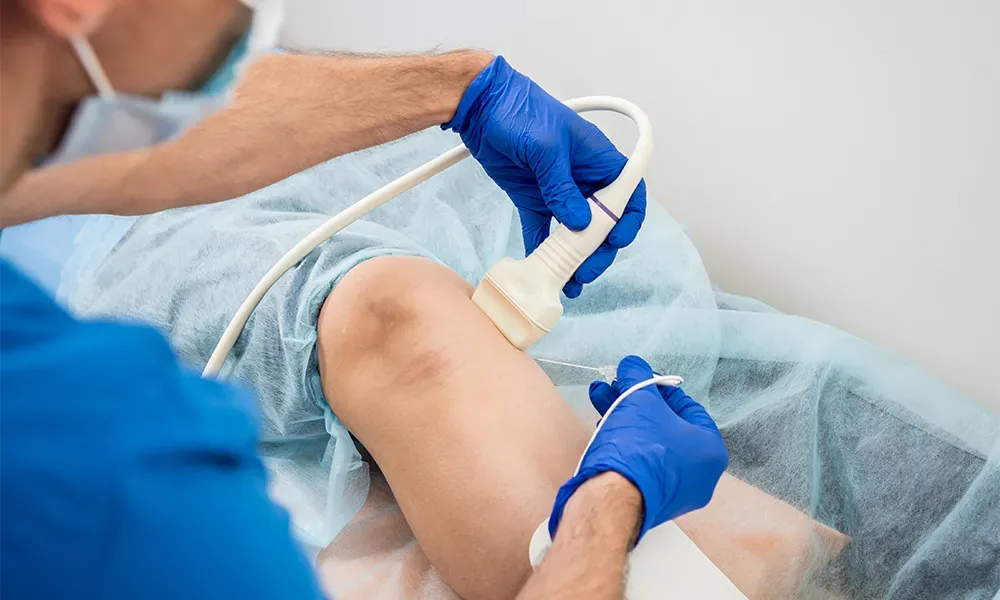
Knee surgery can correct significant joint damage, but pain doesn’t always disappear completely afterward. At Interventional Pain Center in Worthington and Newark, Ohio, Sachida Manocha, MD, evaluates persistent or recurrent knee pain following surgery and provides nonsurgical pain management when appropriate. Call Interventional Pain Center today or schedule an appointment online to discuss your ongoing knee pain.
Failed Knee Surgery Q & A
What does failed knee surgery mean?
Failed knee surgery is a general term for pain, stiffness, reduced function, or other symptoms that continue or develop after a knee procedure. It doesn’t necessarily mean that the operation itself was performed incorrectly.
Persistent pain can occur following different procedures, although it’s particularly well recognized after total knee replacement. Most people experience substantial pain relief after joint replacement, but some continue to have chronic postsurgical pain.
Why might my knee still hurt after surgery?
The cause depends partly on the original surgery. After knee replacement, possible explanations include:
- Infection
- Implant loosening
- Joint instability
- Scar tissue
- Problems with implant positioning
- Patellar tracking problems
- Fracture around the implant
- Nerve-related pain
Pain can also originate outside the knee. Problems involving the hip, spine, muscles, or nerves may produce symptoms that feel like knee pain.
Some discomfort and swelling are normal during recovery, so pain shortly after an operation doesn’t necessarily indicate a problem. After total knee replacement, mild to moderate swelling can persist for several months.
How is persistent pain after knee surgery evaluated?
Dr. Manocha reviews your surgical history and asks when the current pain began, where it occurs, and whether certain movements or activities make it worse.
The type of pain can also provide useful information. For example, burning, tingling, or shooting symptoms suggest a nerve-related component.
Imaging, laboratory tests, or evaluation by an orthopedic surgeon may be necessary when there’s concern about infection, implant loosening, instability, or another structural problem.
Identifying these conditions is essential because some require surgery rather than pain-management treatment.
Does continuing knee pain mean I need another operation?
Not necessarily. Revision surgery may be appropriate when there’s a correctable mechanical problem, infection, or significant implant failure. However, further surgery isn’t necessary for every person with persistent knee pain.
If your knee is structurally stable and you don’t need another operation, Dr. Manocha can assess whether interventional pain management could reduce your symptoms.
Can radiofrequency ablation help with pain after knee surgery?
Radiofrequency ablation targets sensory nerves around the knee called the genicular nerves. Controlled radiofrequency energy disrupts the nerves’ ability to transmit pain signals, potentially providing longer-lasting relief without further joint surgery.
If knee pain continues after surgery, contact Interventional Pain Center to schedule an evaluation and discuss appropriate pain-management treatments. Call your nearest office or book an appointment online today.